For contemporary web users visiting an educational mini-site, the massive multi-hour calculations of Book T are often streamlined into highly accessible, responsive layout configurations. Here is the definitive instruction set for performing a standard, foundational layout at home:
1. Formulating the Query
A successful reading depends entirely on clarity. The querent must focus on an open-ended, active question rather than a passive binary prompt:
Do not ask: "Will I get the job next Monday?"
Ask: "What energies should I focus on to improve my professional career trajectory?"
2. The Shuffling Sequence
Clear the workspace of clutter to enhance visual contrast against your card stock. Shuffle the 78-card deck using whatever physical shuffling style is preferred (overhand, riffle, or washing).
While shuffling, mentally hold the formulated query in focus to conceptually "program" the random array.
Place the deck face down and have the person receiving the reading cut the cards into three piles using their left hand, then restack them in any order.
The One-Card Pull
International Playing-Card Society training manuals, historical cartomancy guides from the Rider-Waite-Smith archive (1909), and 20th-century analytical psychology reading frameworks.
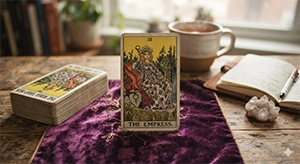
Daily - The One-Card Pull
A single-card focus draw configuration layout. Educational schematic mapping an isolated anchor theme for a daily mindfulness cycle. Graphic asset generated via AI model reference systems (c. 2026).
Best Used For: Daily mindfulness check-ins, rapid thematic insights, or isolated card-study meditation exercises.
Instructions
Deal a single card face up directly into the center of your table workspace.
Interpretation Method: This card does not represent a chronological storyline. Instead, read it as an overarching "environmental theme" or emotional filter for your current 24-hour cycle.
Video of a Daily One-Card Pull
Watch Biddy Tarot demonstrate a one card tarot pull.
Video walkthrough outlining interactive intuitive methods for performing an isolated one-card tarot pull.
Biddy Tarot. (2023, November 1). How to Do a 1-Card Tarot Reading – Even if You’re Completely New to Tarot [Video]. YouTube. Step-by-step intuitive checking process hosted by Biddy Tarot.
International Playing-Card Society training manuals, historical cartomancy guides from the Rider-Waite-Smith archive (1909), and 20th-century analytical psychology reading frameworks.
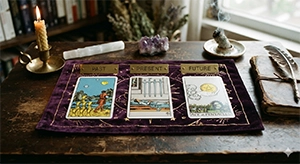
Past / Present / Future - The Three-Card Spread
The traditional three-card horizontal layout matrix. This spatial sequence charts linear timelines across past roots, immediate active choices, and downstream consequences. Graphic template designed via AI generation tools (c. 2026).
Best Used For: Tracking a situation's structural timeline, discovering cause-and-effect patterns, and processing linear problem-solving queries.
Instructions
Deal three cards consecutively from left to right in a perfectly straight horizontal line:
Card 1 (Left Position) - The Past: Represents the root causes, previous choices, or historical forces that built the current situation.
Card 2 (Center Position) - The Present: Represents the immediate environment, active challenges, and the current state of awareness.
Card 3 (Right Position) - The Future: Projects the most likely logistical trajectory if choices and behaviors remain unaltered.
Interpretation Method: Do not read these as three separate, isolated meanings. Read them left-to-right like a sentence or storybook pages, observing how the visual themes flow from Card 1 into Card 3.
Video of a Three-Card Past | Present | Future Layout
Watch Biddy Tarot demonstrate the Past | Present | Future three card tarot layout.
Video tutorial outlining strategies for weaving narrative links across a horizontal three-card spread.
Biddy Tarot. (2023, March 29). How to do a 3-card tarot reading [Video]. YouTube. Structural tutorial focusing on question refinement and card weaving mechanics hosted by Biddy Tarot.
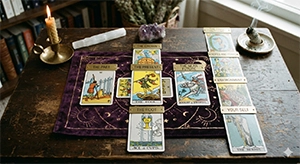
The ten-card Celtic Cross structural spread layout. This layout features a multi-tiered focal node flanked by an axis column to track hidden psychological root dynamics. Graphic asset generated via Google Gemini AI systems (October 7, 2026).
Best Used For: Comprehensive, deeply multi-layered analysis of a complex life situation. This layout utilizes 10 distinct cards to map a player's internal psyche against external environmental forces.
Instructions
The Central Cross Complex:
Card 1 (Center Base): Place this flat in the middle. Represents the immediate core situation or the querent's current baseline identity.
Card 2 (The Cross): Place this card horizontally directly over Card 1, forming a physical cross. This represents the immediate obstacle or active friction blocking progress.
The Surrounding Axis:
Card 3 (Below): Place directly beneath the central cross. Represents the deep subconscious roots or unseen foundation of the matter.
Card 4 (Left): Place to the immediate left of the central cross. Represents recent past events that are currently fading out of relevance.
Card 5 (Above): Place directly above the central cross. Represents conscious goals, idealized thoughts, or what the user is actively focusing on.
Card 6 (Right): Place to the immediate right of the central cross. Represents upcoming energies moving into the situation in the near future.
The Right-Hand Staff (The Vertical Column):
To the right of your central axis, lay down four final cards starting from the bottom and stacking upward:
Card 7 (Bottom of Staff) - The Self: Represents the reader’s inner emotional posture and true alignment.
Card 8 (Second up) - The External Environment: Represents social circles, workplace conditions, or the actions of other people.
Card 9 (Third up) - Hopes and Fears: Represents inner anxieties, psychological projections, or hidden aspirations.
Card 10 (Top of Staff) - The Ultimate Trajectory: Represents the final overarching resolution if all current components play out to completion.
Video of a Ten-Card Celtic Cross Spread
Watch Biddy Tarot demonstrate a ten-card Celtic Cross Spread.
Video walkthrough analyzing card intersections, subconscious positions, and staff variables in a standard ten-card structural array.
Biddy Tarot. (2023, September 12). The Celtic Cross Tarot Spread for Beginners [Video]. YouTube.